📢 Get €75 for every friend you refer! Learn more
Refer and earn


Peer-to-peer (P2P) lending, often termed crowdlending, represents a paradigm shift in financial intermediation, enabling direct capital flow between investors and borrowers via online platforms. Unlike traditional banking, which relies on centralized balance sheets and high overhead costs, P2P platforms leverage technology to streamline credit assessment, reduce transaction costs, and democratize access to high-yield investment opportunities. Since its inception in 2005, the industry has evolved from social lending experiments to a regulated asset class, integral to the modern fintech ecosystem.
The core mechanism of a P2P marketplace like Lendermarket is the matching of diverse funding interests. The process involves several interconnected layers that ensure efficiency and security for all parties involved.
While P2P lending offers attractive yields—often exceeding 15% annually—it is essential to understand the risk mitigation strategies employed to protect your capital.
A cornerstone of Lendermarket's safety framework is the 60-day Buyback Guarantee. Should a borrower default or experience a payment delay exceeding 60 days, the respective Loan Originator is contractually obligated to repurchase the loan. This repurchase includes the full nominal principal amount plus all accrued interest, shifting the credit risk from the individual investor to the professional lending entity.*
It is important to note, however, that the Buyback Guarantee is a contractual obligation of the Loan Originator and is subject to their ongoing financial solvency. The guarantee remains effective provided the Loan Originator does not face insolvency or bankruptcy. As such, investors should consider the financial health of the Loan Originator as part of their overall risk assessment.
*The buyback guarantee is conditional on the LO’s continued solvency and ability to perform its obligations.
In the P2P environment, diversification is the most effective tool for risk reduction. By allocating small amounts—as little as €10—across hundreds of individual loans, investors minimize the impact of any single default on their overall portfolio performance. Professional strategies often involve spreading investments across different loan types (consumer, SME, real estate), various geographies, and multiple Loan Originators.
Lendermarket operates under the European Crowdfunding Service Providers Regulation (EU) 2020/1503, overseen by the Central Bank of Ireland. This harmonized EU framework ensures high standards of transparency:
An expert-level understanding of P2P includes knowing what happens in the event of platform insolvency. Regulated platforms must maintain robust "wind-down plans" to ensure the orderly administration of the loan book even if the platform ceases to operate.
P2P interest income is generally considered unearned income and is subject to taxation based on the investor's country of residence.
Many investors choose to participate in P2P lending through a legal entity (e.g.,Limited company in Ireland,a GmbH in Germany or an OÜ in Estonia). This can provide tax-deferral benefits, as taxes may only be due upon dividend distribution rather than at the moment interest is earned.
As the P2P industry matures, it is increasingly becoming a sophisticated alternative to traditional fixed-income products. Advanced features like AI-driven credit scoring, fractional bond investing, and deep secondary market liquidity are transforming the sector into a mainstream financial tool. With a projected compound annual growth rate (CAGR) of over 20% through 2034, P2P lending is set to remain a key pillar of the global digital finance landscape.
Opportunity to earn higher returns and diversify investment portfolios.
Access to funds at potentially lower rates than traditional banks.

Browse available loans and invest in ones that meet your criteria or activate the Auto Invest setting.

Receive monthly or quarterly repayments until the loan is fully repaid

Reinvest your earnings into new loans or withdraw the funds
Obtaining the ECSP licence was a rigorous journey that took close to two years. It required significant changes across governance, compliance, disclosures and our technical setup. The process demanded substantial time, focus and resources from the entire team, but it also strengthened our internal foundations and future-proofed the platform.
Operating under the ECSP framework brings a higher level of transparency and regulatory oversight. Investors benefit from clearer risk disclosures, structured investor knowledge assessments, and defined safeguards designed to support informed decision-making.
While regulation does add complexity, we believe the outcome is worth it. A more robust framework enables long-term stability, cross-border scalability and access to a more sophisticated investor base, positioning Lendermarket a step ahead as European regulation continues to evolve.
Lendermarket Limited (trading as Lendermarket) provides services regulated under Regulation EU 2020/1503 (the Crowdfunding Regulation)by the Central Bank of Ireland as well as services not covered by the Crowdfunding Regulation.
Risk warning: Investing in crowdfunding projects involves risk, including the risk of losing part or all of your investment. Investments are not covered by any deposit guarantee scheme or investor compensation scheme. Information provided on this article is for general informational purposes only and should not be considered investment or legal advice, or a recommendation to invest. Investors should assess their own circumstances and, when appropriate, seek independent professional advice

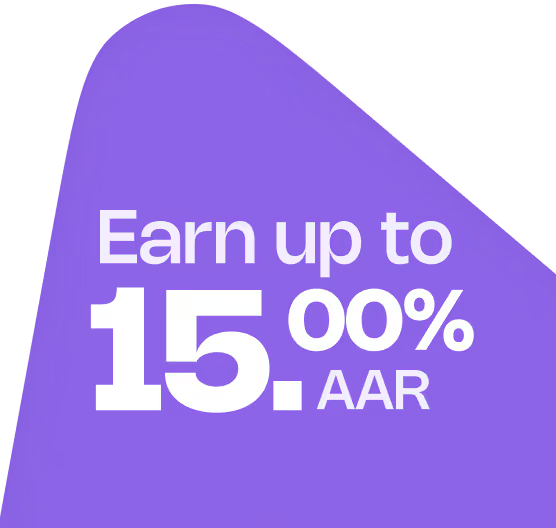
*It is not a guarantee of returns. Investment in crowdfunding projects entails risks, including the risk of partial or entire loss of the capital invested. Additionally, you may not receive any return on your investment. Your investment is not covered by the Deposit Guarantee Scheme.


Lendermarket Limited is regulated by the Central Bank of Ireland. Registered with the Companies Registration Office in Block C, 77 Sir John Rogerson’s Quay, Dublin, D02 VK60, Ireland. Company number 585178.
Lendermarket Limited provides services regulated under Regulation EU 2020/1503 (the Crowdfunding Regulation) as well as services not covered by the Crowdfunding Regulation. For more information, please read our Service Statement, and the
As with all investment opportunities, investments on the Lendermarket platform involve a degree of risk. Lendermarket advises carefully evaluating the risks associated with investing in consumer and business loans and seeking professional advice before starting to invest on the platform. We accept our managers and employees as investors. Our staff have the opportunity to invest in all crowdfunding offers on Lendermarkets platform. The firm ensures that any such investments are made under the same conditions as those of all other investors and that staff do not enjoy any preferential treatment or privileged access to information.We accept our managers and employees as investors. Our staff have the opportunity to invest in all crowdfunding offers on Lendermarkets platform. The firm ensures that any such investments are made under the same conditions as those of all other investors and that staff do not enjoy any preferential treatment or privileged access to information.
Lendermarket offices: Germany: Quartier Potsdamer Platz, Haus 2, Potsdamer Platz 10, 10785 Berlin. Spain: Paseo de la Castellana 141, 5ª planta, 28046 Madrid. Estonia: Sadama tn 4, 10111 Tallinn.
When signing up with Lendermarket, you agree to the Rules of the Platform,
Risk Disclosure Statement, Privacy Policy and Cookie Policy. You can change your privacy settings here.
All Rights Reserved © 2026 Lendermarket Limited.